April 20, 2019

Assam and Meghalaya - God's Own Abode

India is a country full of surprises with so much diversity in its geography, culture and heritage. There are places with which you will instantly fall in love with. North-east is one such region. Each state is unique, with its own cultural identity, liberally blessed by nature.


We started planning for our trip in January 2019 along with our friends our friends Srihari and Anu. We explored different options, finalised plans, and did all the booking. Finally, we visited Assam and Meghalaya in March 2018. We pre-booked our transport, Innova crysta, for the entire journey. Nripen was our driver and companion who took us to the wonderlands of Assam and Meghalaya. His expertise about the region helped us cover everything that we planned for.

While across India there is common timezone (IST), do keep in mind the changed (early) routine of sunrise and sunsets if traveling here from western part of India.

Reaching Assam and Meghalaya

  • Guwahati has a military airport where domestic flights also operate. There are regular flights to Guwahati from all major cities of India.
  • There is an excellent road connectivity between Assam and Meghalaya. It is a 4 hour road journey from Guwahati to Shillong.
Best time to travel
  • Every season offers different reason to travel this beautiful world. Monsoons starts April onwards, and it is a good time for monsoon lovers who want to witness heavy rains. But some of the places, like Kaziranaga remains closed during monsoon, and Dawki river may not be as clean as it is during summer. February/March is end of summer and is generally a good time when most places can be explored.
We started our journey from Lokpriya Gopinath Bordoloi International Airport of Guwahati. We explored Guwahati, Kaziranga, Shillong, Cherrapunji (Sohra) and Shnongpdeng. These places are well connected by road. While Assam is mostly flat lands, majority journey through Meghalaya is on mountain roads.

Guwahati


Guwahati as seen from Bhubneswari Temple

Guwahati is one of the major cities in north-east region, located close to the capital of Assam, Dispur. Located on the banks of Brahmputra, this city is known for its temples. Our stay here was at Baruah Bhawan, a walking distance from the riverbank.

Places to see
  • Kamakhya Temple : Kamakhya is one of most famous temple of north east India. It is located on a small hill, where one can reach by car. It is usually very crowded and takes 5-6 hours for the darshan. We were lucky to do it within 2 hours. Try to reach early in the morning. Further on top of the hill is Bhubneswari Temple, from where a beautiful view of Guwahati is visible.

We also went to Navagraha temple and Umananda temple (on the peacock island in Brahmaputra) here, and crossed Saraighat bridge and IIT Guwahati. Guwahati market is good for Assamese Mekhla saree shopping, and delicious rasgullas.


Kaziranga National Park


Rhino at Kaziranga National Park

215 km from Guwahati, is World Heritage site of Kaziranga National Park. Famous for its Indian one-horned rhinoceros, the sanctuary is also a home to a wide range of animals and birds like Royal Bengal Tigers, Wild Elephants, Swamp Deers, Wild buffaloes, King cobra, tortoise, hornbills, eagles, vultures and stokes. Kaziranga is a part of Golaghat and Nagaon district, and spread across the area of 430 square kms along the Bramhputra river.

There are three major entry gates, western (Bagori), central (Kohora) and eastern (Agaratoli). Decent stay options are available here. We stayed at Sneha Bhawan which was closer to Kohora gate.

Things to do

  • Elephant safari : Exploring the forest on the back of an elephant is an experience to remember. Every morning there are safaris that need to be pre-booked. Elephant safaris covers appx 15 sq km area, and takes us very close to rhinos and other animals. 
  • Jeep safari : Jeep safari covers much larger area, and takes us deep inside the forest. We did multiple jeep safaris, from Bagori and Kohora gates respectively. This is enjoyed best by remaining quiet, observing the surroundings and listening to forest movements. Though we missed tiger by 10 mins, We saw hornbills, eagles, vultures, monitor lizard, rhinos, swamp deers, wild elephants, stokes, variety of tortoise and many different birds.
  • Cultural Program at Kaziranga National Orchid And Biodiversity Park : After the hectic day that was spent mostly in the forest of Kaziranga, this cultural program provides a soothing relief. The group here performs various traditional dance forms and live music, and they are exceptional. There are souvenir shops to carry back memories.

Kaziranga remains closed for visitors during monsoon, May 1 to Oct 31.

Shillong


Airforce Museum
Shillong is a capital of Meghalaya and 3 hr journey from Guwahati. It's a scenic journey as most part of it is in hilly regions. We took a halt at Umiam lake to see the wonderful sunset. Shillong was the coldest place in our trip, and temperature drop is significant. We stayed at the wonderful and well maintained Pine Hill Homestay.

Places to see
  • Elephant falls : This is one of landmarks of Shillong. You'll see couple of waterfalls along the small trek.
  • Airforce museum : Shillong is the head quarter of eastern airforce, and a visit to airforce museum is highly recommended. Museum also has a souvenir shop.
  • Shillong View Point: On top of the hill, within airforce area is a point that provides scenic view of Shillong city. It takes some time getting the entry here due to security reasons. Remember to carry id cards while going here.
We also went to Ward's lake, and explored Police Bazaar area for shopping. City Hut Dhaba is a recommended place for lunch/dinner.

Police Bazaar market remains closed on Sunday, so plan your trip accordingly if you are interested in shopping.


Cherrapunji/Sohra


Nohakalikai Falls

65 km south of Shillong is Cherrapunji, which is locally known as Sohra. It is famous for its rainfall, and we did get a glimpse of it during one of the nights.

On the way from Shillong to Cherrapunji, there are some good places to explore. Meghalaya comprises of large number of caves in Jaintia, Khasi and Garos hills, and few of them are a must visit.

  • Arwah Lumshya Cave : Arwah Lumshya is a natural cave formed within the limestone rock. Along with stalactites and stalagmites, this cave has presence of fossils along its walls and roofs. Journey to the entrance of this cave from the parking is also quite scenic within the forest.
  • Mawsmai Cave: This is another limestone cave that provides good view of the natural formations. Some of the passages are very narrow, and adds to the thrill.
  • Nohakalikai Waterfalls: Nohkalikai Falls is the tallest plunge waterfall in India with the height of l115 feet. It is located quite close to the main town.
There are other waterfalls as well like Wah Kaba and Seven sisters (which is actually beyond Cherrapunji) in this region. Our stay here was at La Kupar, which was quite well maintained, offers campfire and provides amazing night sky view. Orange roots restaurant on this way offers good food.

Nongriat - Double Docker Living Root Bridge
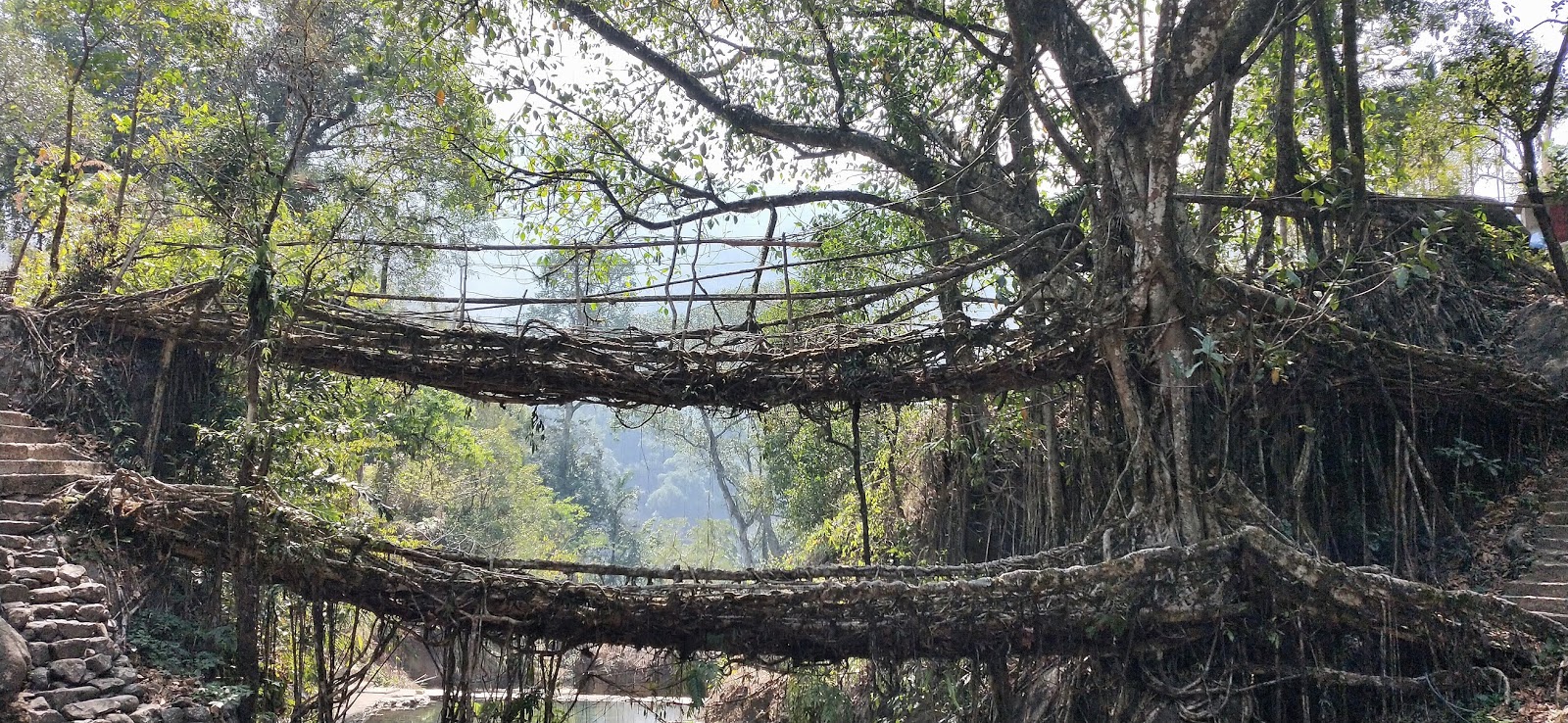

Double Decker Living Root Bridge

Meghalaya is a land of living root bridges, and double decker living root bridge of Nongriat is a special one that has two levels. It is a trek down of 3500 steps to reach here. It is recommended to start the trek very early in the morning. Guides are available for hire here.

We started the trek at 8:00 am and carried breakfast with us. The trek has cement stairs at more places along the slopes of the hill. Along the way, we cross few small streams and couple of single level root bridges. It took us 1:45 mins to reach the double decker bridge. There is a small waterfall and a stream near the double decker bridge. From here, you can trek further to reach Rainbow and NohaKalikai falls though we didn't do that in the interest of time. After exploring the bridge and doing photography, we started the return journey upwards. There are small shops along the way, as well as drinking water outlets. We finally reached the top at 1:15 pm, headed straight to Jiva resort for a well-earned lunch!

There are students here who do this trekking everyday to reach their school.

Dawki/Shnongpdeng


Wah Umngot (Dawki River)

Further south of Cherrapunji, along the Bangladesh border is the town called Dawki. The road is along the hills, and as we reach near Bangaldesh, climate will be a bit hotter.

Along the way, we stopped at Mawlynnong, Asia's cleanest village. It's small village, and also has a living root bridge. Dawki is the last town on Indian side of the border, which is connected to Tamabil of Bangladesh by  road. We visited India Bangladesh Friendship Gate which is the entry point for either country.

From here, we went to Shnonpdeng, a small village established along the Wah Umngot (Dawki River). The stay here was in wooden cottages constructed along the slope, though one can book tents as well. Cottages provides direct view of river. This is one of the cleanest rivers, with river bottom visible. We did boating in this river for close to an hour. There are also options for kayaking and snorkeling. Crossing the suspending bridge over the river is a must act, and gives a good view of the river. River is full of pebbles and stones, and sitting here with feet soaked in river water is a calming experience.

During rains the river becomes muddy, but January onwards the river has crystal clear water. 


At Kaziranga Cultural Center
More pics can be found at - https://www.instagram.com/nimeshddesai

November 28, 2018

Bhutan - The land of happiness


We visited this beautiful country during November 2018, and it turned out to be one of the most memorable experiences. This mountain country is neither too rich not too poor. It has monarchy with democratic government reporting to the King. Bhutan is what India could be with lesser population, better respect for each other and gratitude.

Bhutan is located between India and China, and is well connected by road with India. Roads in Bhutan are maintained in collaboration with India under Dantak project.

We were lucky to have Pasang Tshering (or PK) as our guide and friend there. He took care of all the travels, hotel accommodations and food. He also made us familiar with the Bhutanese culture, history and art. Bhutan was the first country visited by India's current Prime Minister Narendra Modi, and PK  was quite happy about this!

Reaching Bhutan:
  • The only airport of Bhutan is in the hilly regions of Paro, and Druk Air provides flights from Delhi/Kolkata, though these are quite costly.
  • Nearest Indian airport is Bagdogra in northern West Bengal. Bhutan border is usually a 4 hour road journey from Bagdogra, though keep in mind the traffic if you have a return flight to catch.
Best time to travel:
  • Except the months of monsoon, Bhutan can be explored during any season, though in each season, we might see different shades of Bhutan. September-October are good for people who want to do rafting or prefer lesser cold. It gets colder from November onwards, with peak during January. March/April provides scenic views during Spring.


View from Khamsum Yulley Namgyal Chorten

During our travel, we covered Phuensholing, Thimphu, Punakha/Wangdue and Paro. All these are quite small towns compared to big populous cities. Travel from one town to another is mostly along river on mountain roads, and those journeys are very soothing experiences. It can suddenly get cold as we approach pass (or La in Bhutanese), so keep the winter clothes ready.

Ngultrum is Bhutanese currency, but Indian currency is easily accepted in Bhutan at most the places. Both can be used interchangeably as they have the same valuation.

Interesting trivia - 1:
There were no televisions in Bhutan prior to 1999., and Bhutanese people are fond of Indian music, especially 70-80s Bollywood.

 
Our Travel Itinerary

Phuentsholing


Phuentsholing is an entry point to Bhutan from India. India-Bhutan share an open border here, separated by a wall. On the Indian side, there is Jaigaon of WB. One can easily move between two countries through gates. We stayed at Hotel Namgay during our arrival and departure. Bhutan timezone is 30 minutes ahead of India, so make sure to calibrate your watches here. So on Indian side of border you may have 5:00 pm, while just a few steps away at Bhutanese side, it will be 5:30 pm!

Phuentsholing itself is a very small, clean town, stark in contrast to its Indian neighbour Jaigaon.  One can do a walk around the town, visit the monastery and park here. This is where the immigration is done to enter the hilly regions of Bhutan.

For immigration, one would require to submit id proof (Aadhar/Passport), travel itinerary and photographs. Remember that immigration office is closed on weekends and it takes 1 to 2 hours to get the immigration done. Plan your travel accordingly to get it done in the morning.

On the way from Phuentsholing to Thimphu (near Dantak canteen)

Thimphu


Once you cross Phuensholing, the mountains of Bhutan starts. Our next destination was the capital city, Thimphu. It is a 5 hour journey from Phuensholing to Thimphu. We cross small villages/towns like Gedu, Chukha along the way, as well as famous Dantak canteen. An Indian meal at the canteen is recommended. This road provides multiple water falls, river valleys for the photo enthusiasts.

Thimphu is the place where the King lives, in this beautiful town surrounded by the mountains and blessed by Buddha. With a population of hardly 1.15 L, staying here is a calming experience.  We stayed at Hotel Kenny during our Thimphu journey.

Thimphu - as seen from Buddha Dordenma

Places to visit:
  • Buddha Dordenma
    • Probably the biggest sitting Buddha statue (54 mtr) in the world, this place is a must-see in one's Bhutan itinerary. The statue is located on top a mountain, overseeing Thimphu town. There is a chorten below the statue that houses 1,25,000 small Buddha statues.
  • Folk Heritage Museum
    • Museum showcases a traditional Bhutanese house.
  • National Institute for Zorig Chusum
    • Art and craft school
  • Bhutanese Paper Factory
One can also see King's Palace, Assembly Building and Thimphu town from a view point. There are other places like Memorial Chorten that we only visited from outside.

Buddha Dordenma
Food:
  • Though Bhutan is known for its non-veg variety of dishes, one can find chapati, rice, daal and mix-veg in most parts. Do try veg cheese momos at Zombala restaurant.

Interesting trivia - 2:
There are 20 Dzongkhag (districts) in Bhutan, each having their Dzong, an administration and religious fortress.


DoChu La


DoChu La Memorial

DoChu La is the highest point between Thimphu to Punakha. There are 108 memorial chortens built by former queen in honour of the Bhutanese soldiers who were killed in the December 2003 battle against Assamese insurgents from India, and to commemorate King's victory.

One can see Himalayan mountains from this point given the sky is clean. Bhutan's highest mountain Mt. Gangkar Puensum is also visible from here. There is also a monastery and a cafeteria at the pass.

Punakha/Wangdue Phodrang


Punakha Dzong

Our next destination was Bajo town of Wangdue Phodrang. Bajo is a well-maintained town, with monastery and children park, and small parallel lanes. This is where we also enjoyed traditional Bhutanese food, Kewa Datshi (Potato Cheese). Ema Datshi (Chilli Cheese) and Shamu Datshi (Mushroom Cheese), along with Karela (bitter gourd). We stayed at Hotel Rigsum in Bajo town.

Places to see:
  • Punakha Dzong
    • This is one of the most significant Dzong in Bhutan. The Dzong is located at the confluence of Pho Chu and Mo Chu rivers. This where Royal coronation and Royal weddings take place. Dzong has giant statues of Buddha, Padmasambhava and Zhabdrung. The administrative unit of Dzong also houses a bodhi tree. This is where the festivals are celebrated.
  • Khamsum Yulley Namgyal Chorten
    • 9 km from Punakha Dzong along the Mo Chu river, is Khamsum Yulley Namgyal Chorten. The chorten is located on a hilltop, and it is a 45 minute trek to reach there. It's a 3 storeyed chorten that provides stunning views of the river and mountains from the top.
  • Suspension Bridge
    • At 160 mtr, Punakha's suspension bridge is the longest in Bhutan. Walk on this 160 mtr suspension bridge over Pho Chu river brings mixed feelings of fun and fear! One can enjoy ice cream and other snacks on the other side of the bridge.
We also went to river beach under Wangdue Phodrang Dzong in a chilling cold, and enjoyed hot tea on the near-by bridge. There is also Chhimi Ihakhang in this region, where we didn't go.

Interesting trivia - 3:
Bhutan's total population is only 7.5 lakhs. One can only be a citizen of Bhutan by birth, that too when both the parents are of Bhutanese origin.

Chele La


Sunset at Chele La

Chele La is one of the highest pass in Bhutan. It is an hour drive from Paro, located at the altitude of 3988 mtrs. We saw yaks, Himalayan monal and other wildlife along the way. There is also a point on the route from where Paro airport can be seen from the top.  The weather at top is windy and chilly, and it was even difficult to keep the hands out. We reached there at 5:00 pm, and were lucky to see the sunset. By the time we returned, the outside temperature was already 2°C at the pass.

Interesting trivia - 4:
There is no railway line in Bhutan. Also there are no road tunnels in the mountains.


Paro


Our last destination on this trip before returning to Phuentsholing was Paro. Compared to Thimphu, Paro weather is much chilly, but it provides a nice clean sky at night with lot of stars. Bhutan's only airport is also located here, and it is a nice drive parallel to the runway. Surrounded by mountains on all four sides, it is one of the most difficult airport to navigate. We stayed at Hotel Silver Pine in Paro.

Like other Dzongkhags, Paro has it's own Dzong. There is also a National library of Bhutan here. We didn't go to both of these places, but rather explored local market and even got good herbs.

Paro Takshang (Tiger's Nest)


Takshang Monastery

Taksang monastery is a holy sight in Buddhism. It is believed that Padmasambhava (Guru Rinpoche) flew to this location from Tibet on the back of a tigress, and did meditation here. The monastery was destroyed in a fire in 1990s, but was re-built. It is a sight worth visiting.

Takshang base is a half an hour journey from Paro. From the base, it is a three hour trek to reach the monastery. Most part of the trek is on muddy mountain, with steep steps near monastery. We started early at around 9:00 am, and came back by 3:00 pm. The trek is long and requires reasonable physical efforts, but can be done by people of all age group. We met small kids and seniors, and even blind person, during the trek. There is a cafeteria half way in case you need to reenergise yourself.

We would recommend having traditional hot stone bath after the trek. There are few resorts in Paro providing this facility, and it is worth doing it. Herbs are added in the hot water, and it takes away all the fatigue.

Note:
  • Carry minimum luggage while doing the climbing. Instance energy snacks are good to have.
  • Keep a water bottle. There are multiple places from where water can be re-filled.

Interesting trivia - 5:
Primary and secondary education is free in Bhutanese schools. If the student scores well, Bhutanese government also give scholarship for further studies in India.


With Pasang Tshering, our freind and guide

More pics can be found at - https://www.instagram.com/nimeshddesai


December 23, 2016

A Trip to Himachal - Part 2 - McLeod Ganj

Second Destination: McLeod Ganj

How we reached there:

Khajjiar -> McLeod Ganj (via Jot, Chowari, Dharamshala) : Hired Taxi, takes 4.5 hours
McLeod Ganj -> Amritsar -> Pathankot : Hired Taxi, takes 5 hours to Amritsar and 2 hours to Pathankot from there

Places to stay:

There are number of options available on oyorooms, makemytrip and goibibo as well on HPTDC. You’ll get good home-stay as well. Prefer hotels near main square. We stayed in Hotel Castle (through oyorooms), near on Bhagsu Road.

Places to eat ( esp vegetarian ):

McLeod Ganj has a range of food options for Tibetan, Italian and Indian food. Some of our favourites are:
  • Nick’s Italian Kitchen
  • Hotel Tibet
  • Chocolate Log
  • Spring Valley Restaurant
      Needless to say that one must try momos in this part of the World, and apart from restaurants, there are road-side eateries offering good momos.

      Places to visit:

      From nature to history to religion to cricket, McLeod Ganj and Dharamshala has everything one can ask for.

      • Namgyal Monastery/Dalai Lama Temple and Tibetan Museum
      • McLeod Ganj is an official residence of His Holiness Dalai Lama and a headquarter of Tibetan government in exile. Dalai Lama stays at Namgyal monastery which is a must visit place. This buddhist monastery has spiritual aura that brings instant calmness.  Chants of 'Om Mani Padme Hung' and Prayer wheels are essential parts of this unique experience.

        There is also Tibetan museum within the temple premises, highlighting struggles of Tibetan people and their migration from Lhasa to India. 

      • Norbulingka Institute
      • Located near Dharamshala, this institute is named after Norbulingka, the traditional summer residence of the Dalai Lamas, in Lhasa, Tibet. It is aimed to preserve Tibetan tradition and provide training, education and employment to Tibetans. You can see Tibetan metal art, drawings and other artistic forms in action here. Losel Doll Museum is quite interesting. There is a souvenir shop to collect memories. And while you are at it, do try ginger lemon honey tea!
      • Bhagsunag Waterfall
      • Earlier morning visit to Bhagsunag Temple, trek to Bhagsunag waterfall and visit to Shiva cafe is another important thing to do while you are in McLeod Ganj. Bhagsunag Shiv Temple is located near the taxi stand on Bhagsunag road. Everything is anyway at a walking distance in McLeod Ganj. It's a 1.5 km trek to the waterfall from the temple, normally takes 30 mins. The trek is scenic, and the waterfall is chilly. Then you trek further up to Shiva cafe. It provides a nice view to the valley on one side, and Triund mountain on the other. Cafe provides variety of food option if you are tired after the trek.
      • HPCA Stadium
      • This famous Dharamshala cricket stadium is a sight to visit. Surrounded by mountains, it is one of most scenic cricket stadium around the world. Entry is free when there are no matches and you can go up to visitor's gallery.
      • Kangra war memorial
      • This is one of the location that our cab driver took us to while roaming around in Dharamshala. This war memorial is built in the memories of the martyrs of Kangra valley.
      Apart from these places, walks on the streets from main square to monastery are a must once you are in McLeod Ganj. Slope adds much fun to those evening walks. Located on both sides of the streets are various shops to satisfy your shopping urge. And don't miss the sunset from there!

      HPCA Stadium

      Bhagsunag Waterfall

      Shiva Cafe

      What next?

      After a three day stay at McLeod Ganj, we went to Amritsar, which is a 4.5 hrs drive from here, during our return journey. I had already covered Amritsar in my earlier post, but the location has changed significantly in these 7 years. We spent the afternoon at the Golden Temple and enjoyed food @ langar. Next we went to Jallianwala Bagh, the famous historic place, adjacent to the temple. We did go to Delhi after this, but could only cover Rajghat, Humayun's Tomb and Qutub Minar before our return flight to Pune.

      Humayun's Tomb

      December 19, 2016

      A Trip to Himachal - Part 1 - Khajjiar

      How we reached there:

      Pune -> Pathannkot : Train journey via Jelum Express, takes 38 hours
      Pathankot -> Khajjiar (via Dalhousie) : Hired Taxi, takes 4 hours, keep the stomach empty as it will be a roller-coster hill-side ride

      Places to stay:

      Khajjiar - Hotel Devdar, a part of HPTDC hotels, provides the best possible location for this place. Apart from this, there are other options like Mini-Swiss facing other side of mountain.

      Places to eat ( esp vegetarian food ):

      • Hotel Iravati in Chamba has wonderful dishes of Gucchi (a kind of Mushroom) and Chamba Kadhi.
      • Street-side food options, esp Parathas, are quite good in this part of the region

      So after a continuous journey of close to 43 hours, we finally reached our HPTDC Hotel Devdar in Khajjiar during the early part of noon. The lush green meadows in front of us instantly removed all the tiredness. Khajjiar is a very tiny hill station of Himachal, sometimes referred to as a Switzerland of India. It has a centrally located small lake, and surrounding meadows on slope all around. It is surrounded by trees and mountains from all side making it picture-perfect. There is a Khajjiar Nag temple, based on which this place is named ‘Khajjiar’. There are small treks all around, and morning walk towards other side to see sunset is worth the efforts. There is also a vaishnodevi temple at a walking distance, with huge Shiva statue.

      Things to do:

      During day time, the meadow is full of activities with tourists coming there from near-by places. Horse-riding is quite common. Grass and slope offers sports like Zorbing, which is a must try. One can also do paragliding on the other side of the mountain.

      Nearby Places:

      • Chamba: At 22 km distance from Khajjiar, Chamba is located along the river Ravi. Laxmi Narayan Temple is a must visit place there. There is also a Bhuri Singh Museum to know a bit of history of the place. If you are lucky, may get to see cricket match in the central Chamba ground!
      • Dalhousie: Dalhousie is yet another hilltop tourist place, with Tibetan market and a lot of street shopping. There is a wildlife sanctuary, Kala Top, on the way to Dalhousie. This road also takes you along multiple hillside schools.


      (Part 2 will take you to McLeod Ganj and ahead)

      December 3, 2010

      Goa

      Goa was one destination I always wanted to go since my childhood but could never go for first 25 years. But since then I have been there 4 times in last 3 years, each journey with a different group of people. Each journey has been a different experience and ideally I should have written four different blogs for those!

      How to reach: Regular flights from all major cities of India, Direct trains to Madgaon and Vasco from major junctions

      Places of Interest: Mangeshi Temple, Shantadurga Temple, Basilica of Bom Jesus, Dona Paula point, Big Foot (Ancestral Goa), Old Church of Panaji, Aguada Fort 

      Beaches: Miramar, Colva, Calangute, Baga, Arambol, Palolem, Varca, Anjuna

      Food: For a non-vegetarian, there are plenty of options. For vegetarian like us, options are limited but they are available all around Goa. We found Rajadhani in Panaji a better choice.

      Goa is located on the western ghat of India. Goa state has been divided in two districts: North Goa and South Goa. During my recent visit, we decided to go Goa by train from Pune and to explore the South Goa. Our stay was in Margao Residency governed by Goa Tourism. There are some advantages of going to Goa by Train. There are many tunnels on the way and of course, there is Dudhsagar water fall.

      For most tourists, Goa is a land of some wonderful beaches. We explored Varca beach and Colva beach which were nearer to our hotel. Colva beach being a more popular one is always crowded and offers variety of water sports. Varca is lesser known and therefore is preferred by visitors who want to avoid crowd and enjoy the soothing Arabian sea. One can easily get vehicles on hire for reasonable rates in Goa. We hired one two wheeler and explored the area around Madgaon.

      P-1 Sunset at Colva Beach

      Goa tourism organizes daily site seeing tours to North and South Goa. There are other special tours also. Next day we decided to go for the South Goa site seeing. This gave us chance to explore Goa mainland and its culture. We visited Shantadurga Temple and Mangeshi Temple. We also explored various churches of Old Goa including the Basilica of Bom Jesus which houses the relics of St. Francis Xavier. This journey also took us to Big Foot – Ancestral Goa. As we roam around in the village created, we come across various idols which depicts the culture and life style of Goa. It also has Saint Mirabai sculpture which is India’s longest laterite sculptor. There was also a Portuguese house there which depicted lifestyle of Portuguese who once rules Goa.

      P-2 Basilica of Bom Jesus

      Though we visited Panaji during our South Goa site seeing tour earlier, we decided to explore more on two wheeler. Panaji is around 30 km from Madgaon and it was a pleasant journey on NH-17 as the weather was not-so-cool-not-so-hot. Panaji(or Panjim) is one of the beautiful city of India. Nicely constructed roads, road-side greenery and well maintained market add to its beauty. We spent some quality time at the Miramar beach before heading to the famous Panaji Church. Located in the center of the city, this is one of the picturesque churches around Goa. One might have seen it in some Bollywood movies shot in Goa! After exploring the church, we went to Dona Paula point. Again this point has been popular for movie shootings. It has a nicely constructed platform where one can sit and enjoy the vast sea in front.

      P-3 Panaji Church

      As always happens with Goa, we never realized how days went by but we enjoyed every moment of our stay in this beautiful place. There are many places in Goa apart from the ones mentioned here which I explored during my earlier visits. Surely I would like to cover them in my next blog on Goa!


      October 7, 2010

      Bhandardara

      Akshar Bharati is a social organization which provides very good opportunity for the volunteers to get connected with little kids and spread knowledge by setting up libraries for them. Jyoti and I have been active members of Akshar Bharati since we came to Pune and have enjoyed many activities over the last few years.

      Recently Akshar Bharati organized an exciting nature trail to Sahyadri covering Bhandardara, Randha falls, Pravara River, Amruteshwar Temple and many other points on the way along with library set up activities at two locations.  We participated in this fun-filled activity along with other 30+ members.
      P-1 Randha Falls

      We started our journey on Saturday early morning from Pune and our first target was ZP school of Kothe gaon of Sangamner district. We donated books to start a library for the kids of that school and spent some quality time with those kids. Despite being a holiday, kids came to the school to take part in this function. The smiles on their faces and sparkles in their eyes made our trip successful. After having a refreshing breakfast arranged by Vandana Jadhav who is also one of the volunteer of Akshar Bharati, we continued our journey. Next we reached Randha falls. We had a lot of fun in the water there and it felt really nice to get wet in scorching heat.

      P-2 Bhandardara Dam Backwaters

      At the time of lunch, we reached Shendi village after crossing Bhandardara Dam(Wilson dam). Our next target was Amruteshwar Temple at Ratangad. We continued our journey on narrow roads of Sahyadri surrounded by beautiful lush green hills and grounds. We reached the temple in the afternoon. It is a temple of Lord Shiva. It's an ancient temple having beautiful carvings. The temple is in the foothills of Ratangad. One can also see Maharashtra's highest peak, Kalsubai from here. We were accompanied by Swamiji at the temple who is also looking after the library Akshar Bharati started at this place earlier. In his company, we shared peaceful time there and also enjoyed musical mehfil of religious songs.

      P-3 Amruteshwar Temple

      After having our dinner in Shendi, we reached Indori of Akole taluka at night. This is where we spent our night in the house of  Bhanudas Abhale. The house was surrounded by beautiful farms. We also had camp-fire for short time and discussed the stars and the constellations. The long day thus ended here and I had the most peaceful sleep during that night!

      P-4 Sunset at Ratangad

      Next morning was a refreshing experience for all the volunteers. We spent some quality time in the farms full of sugarcanes, carrots, sorghums, cucumbers and bottle gourds. We then headed to Vanvasi Kalyan Ashram where we started another library for the kids staying there. We also enjoyed scientific toys demonstration by Suraj. We then visited Agasti Rishi's Ashram at a nearby place before having our lunch. In Lunch, we enjoyed the real taste of village's delicious food. After having filled our stomachs with tasty food and lots of love, we started our return journey. We enjoyed lots of games, songs and dances on the way. We all stayed like a big family for two days and never realized how quickly those two days went by. I thank all the organizers who planned such a wonderful trip and brought us close to our culture and values.

      June 27, 2010

      Andaman - Port Blair and Havelock Island

      There were many locations my wife Jyoti and I considered for our honeymoon in December 2008 including Shimla, Manali, Leh, Lakshadweep, Singapore. But finally we both agreed to go where we would have really loved to spend the beautiful time together away from city life. And we chose Andaman. I started planning for this trip at least 5 months in advance and got good help from my friends who have been there before. I contacted Andaman tourism and after some discussions over email, finalized my itinerary and hotel reservations.

      Andaman and Nicobar are group of many islands, some of which are now commercially developed. But rest are still residents for the local tribes. There is a legend that Lord Hanuman once reached these Islands and stayed here for some time. And the name Andaman actually derived from Hanuman. Our 8 day journey in December, 2008 was limited to Andaman Islands. One needs longer stay to reach and explore Nicobar Islands as they are farther away from Port Blair, the main Airport on these islands. In eight days, we explored Port Blair city, Ross Island, North bay, Chatham, Chidiya tapu and Havelock. 


      Port Blair Jetty


      Port Blair
      How to reach: Regular flights from Chennai and Kolkata airports, Chennai-Port Blair cruise service
      Places of Interest: Cellular Jail, Sagarika emporium, Samudrika Marine museum, Mini Zoo, Corbyns Cove beach, Chatham saw mill, Chidiya tapu, Science Museum
      Nearest Islands: Ross, North Bay
      Food: For a non-vegetarian, there are plenty of options. For vegetarian like us, options are limited but they are very good. Annapurna restaurant in Aberdeen Bazar was our preferred choice.

      We reached Port Blair Airport from Chennai in a 3 hr flight. We were received by our driver Mr Sanjay at the airport and for the remaining journey he used to become an important part of our stay there. Port Blair is a beautiful city, the most beautiful city of India in my opinion! Nicely constructed almost empty roads and easiness in the air was a welcome change from busy metro life. Looking at its current development, it becomes hard to imagine that a century ago this place was a synonymous for one of the most brutal punishments. 


      The place which was feared by many was the very popular Cellular Jail. It was a home to many Indian Freedom fighters who were sent to these Islands to crush their enthusiasm. Post-independence, Cellular Jail has been converted into the National Memorial to pay tribute to all those Freedom fighters who once lived here. We attended the Sound-and-Light show at the Cellular Jail at night and came to know about the struggle our Freedom fighters faced here. 


      During day time, we visited the Jail again and this time we went inside to see the cells and gallows. The jail is a huge structure, originally having 7 wings. Four of which were destructed by Japanese Air strike during World War II and remaining three still exists today. There is a special cell in one corner on second floor of one of the wings, just opposite to gallows. There lived a special prisoner who made a significant impact on Indian Freedom Struggle. His name was: Vinayak Damodar Savarkar. Savarkar wrote poems in
      Marathi on the walls of his cell and some of this work can still be observed today. The Cellular Jail is located very near to the sea and nice breeze of air is felt when you reach top of the jail. There is a museum inside the jail which depicts lives of prisoners and message of patriotism.

      Port Blair has a very well constructed jetty and harbor to reach different surrounding islands via boats and ships. We visited Ross Island and North bay in small boats. Ross island used to be a home for British officers in pre-Independence era. It was destructed to a great extent during Tsunami in December, 2004. There are still some houses, offices and church left on the island. We also encountered some deer roaming in the open area during our stay there. North bay is a very small island, mainly thrives on snorkeling and scuba diving activities. The island is surrounded by very beautiful coral reef and doing snorkeling there was a life-time memorable experience.

      During our stay at Port Blair we also visited Samudrika marine museum, Mini Zoo, Corbyns Cove beach and Science museum. Sagarika emporium is an official store to purchase handicraft and spices for which Andaman Islands are famous.   We also drove to Chidiya tapu, around 2 hr journey from Port Blair. It was famous for water sports but was destroyed in 2004 Tsunami. It was being redeveloped when we were there. On our last day, we went to Chatham Saw Mill. It is considered to be one of the biggest saw mills of Asia and it’s a heritage. It was attacked by Japanese fighter planes in World War II and Post-independence it was rebuilt. 


      On the way to Havelock

      Havelock
      How to reach: Small passenger ships from Port Blair, 2-3 hrs
      Places of Interest: Radhanagar Beach
      Food: Hotels do provide good food but there is a restaurant named Royal Palace in the market especially for people who prefer north-Indian style food

       Mangroves

      Port Blair is a beautiful city, but it does not have any popular beaches. To explore the sea, we decided to go to Havelock. Havelock is a small Island situated at around 57 km North East of Port Blair. It comprises of 5 very small villages and there is single main road of appx 11 km which runs through the Island. We started at 6 am in the morning from Port Blair and reached at around 10 am. Our hotel was adjacent to a small beach and we can see mangroves from our cottage. After spending some time at our hotel, we headed straight to Radhanagar beach. Despite being a small isolated island, one can find auto rickshaw easily there. Recently ATMs of few banks have also been set up there. 

      After crossing the market, we reached Radhanagar beach. And the very first impression was that nothing can be more beautiful and peaceful than this in this world! Radhanagar beach is considered the most beautiful beach of Asia, and should be very close to being best in the world. There is clean sky blue water, not too deep for few hundred meters. There is very soft sand on the beach, and the beach itself is surrounded by green forest from one side. Unlike many beaches in India, there is ample of space available for you to relax.  


      Havelock has been a preferred destination for many Europeans and Israelis and we found many on Radhanagar beach. The blue water was so tempting that we directly jumped into it and spent entire afternoon there. The beach is on the western side of Havelock and provided the best view of sunset. As with other Andaman and Nicobar Islands, Havelock follows Indian Standard Time (IST). But being on the eastern side of the country, day begins early and ends early. We witnessed the marvelous sunset at around 5pm and returned back to hotel. Next morning, we again reached Havelock and enjoyed elephant ride on the beach. At Radhanagar beach, we also tasted the sweetest coconut water.  

      We couldn’t manage to go to the Elephant beach which is known for snorkeling due to lack of time. There are also Islands around Havelock having very beautiful coral life and one can enjoy snorkeling and scuba diving there. After filling our hearts with the beauty and simplicity of Havelock, We returned to Port Blair on second day evening. I would also like to thank our friends whom we met in Port Blair and who made our Christmas special.